Efficient grain storage: how TAS Agro reduced drying costs
Save money on drying
TAS Agro has significantly reduced its production costs by switching from natural gas to solid fuel
Extremely low grain prices are forcing Ukrainian farmers to seek new ways of optimising costs in order to achieve a reasonably normal return on crop production. This is particularly true of maize, which, given the high capital investment required per hectare of cropland, also necessitates significant post-harvest drying. Sometimes it is necessary to ‘remove’ as much as 20 or even 25% of excess moisture from the harvested grain.
However, in many cases, the cost of natural gas effectively wipes out farmers’ potential profits. The situation is no better for commercial grain elevators, whose management is forced to operate right on the break-even point, using expensive natural gas.
However, there are ways to overcome such a difficult situation, and the experience of the well-known company ‘TAS Agro’ will prove useful here. In particular, the company’s management has significantly modernised the operations of its grain elevator in the Chernihiv region, which has helped to improve the financial position of the facility and the company as a whole.
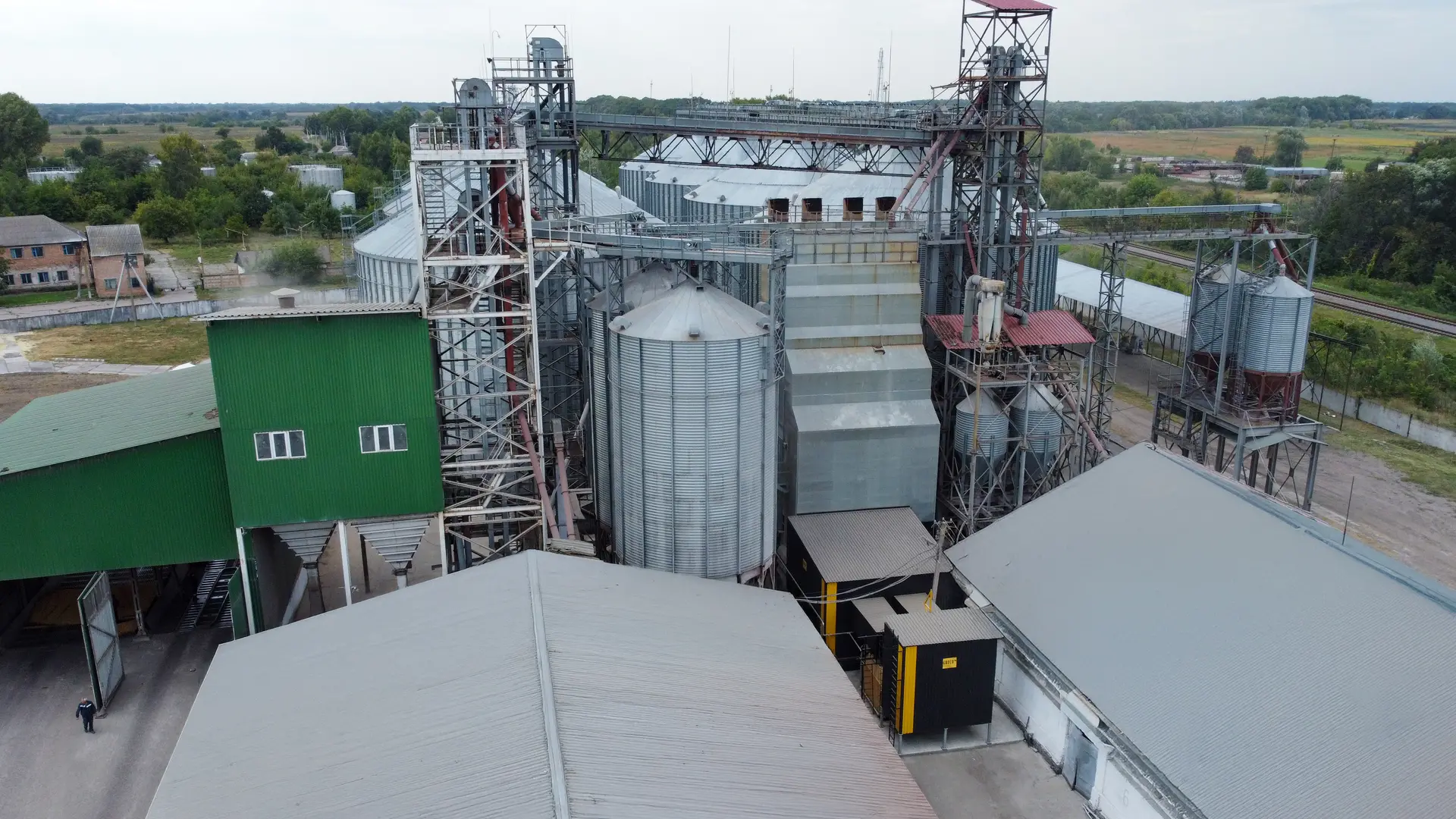
TAS Agro has owned this large grain storage facility for 11 years; at the time of purchase, it consisted solely of floor storage areas. Year after year, the company has significantly upgraded its facility by installing modern equipment, including metal silos, grain dryers, transport equipment and so on.
___________________________
Over the course of the calendar year, the facility managed to achieve an average of 2.5 storage cycles using only its own grain
___________________________
Ultimately, the total capacity for simultaneous grain storage reached almost 60,000 tonnes. Over the course of the calendar year, the facility managed to achieve an average of 2.5 storage cycles for its own grain alone. In other words, during the season, up to 150,000 tonnes of grain were handled at this TAS Agro grain elevator.
A logistics infrastructure was established to handle such substantial volumes of produce. In particular, rail transport was actively used to ship grain. There are two rail and one road loading bays.
The situation has now deteriorated for well-known reasons linked to difficulties in grain exports. We have even had to temporarily stop accepting grain from third-party companies, as our current capacity is only sufficient to handle our own grain.

The grain elevator is fully equipped with modern, high-performance machinery for the complete cycle of processing, storage and transport of the produce.
Glib Isichko, Director of the ‘TAS Agro’ grain storage division, noted that the development of the company’s own grain silos is a strategic priority. For example, the northern cluster is set to have a storage capacity of 100–110 thousand tonnes, and active work is already underway in this area. For other grain elevators, calculations are being made to determine actual needs and decide on the company’s overall strategy. An improvement in the economic performance of grain storage enterprises is already evident: they are becoming more efficient and productive. And, despite these challenging times, development continues.
It is important to note that, given the current difficult conditions for grain storage, the grain elevator requires a significant expansion of its capacity; consequently, some of the maize will be stored here in polyethylene bags. However, other options for the development of the grain storage facility are also possible, as it is very difficult to market the harvest at present, particularly in the case of early-maturing cereals and maize. There are plans to increase simultaneous storage capacity to 90–100 thousand tonnes of grain. In particular, six new metal silos will be installed.
The grain reception capacity at the TAS Agro grain elevator in the Chernihiv region currently stands at 100 tonnes per hour. The harvested grain is cleaned using KBS drum separators manufactured by KMZ Industries. Grain drying is carried out using a modern unit from the renowned Swedish manufacturer Tornum, as well as advanced domestic DSP50E dryers.
It is worth noting that the Tornum dryer achieves a throughput of 58 tonnes per hectare when reducing the moisture content of maize by 10%. Thanks to these high figures, the Swedish dryer processes a good two-thirds of the grain delivered to the grain elevator.
All domestic farmers are well aware of what is happening in the post-harvest grain processing sector, particularly with regard to maize. Almost every year, it is physically difficult to harvest wet maize from the field, difficult to transport, and very expensive to bring it down to a base moisture content of 14% and put it into storage. All this was difficult even before the full-scale war began, let alone last autumn and the current season…
The management of the grain storage facility has therefore decided to implement a series of effective measures to restore the facility to normal operation and improve its profitability.
For example, at the TAS Agro grain elevator, following the onset of significant power cuts, it was decided to purchase a generator to meet at least the basic electricity requirements. This made it possible to keep operations running without interruption, thereby maintaining productivity and the quality of work.
However, the main project carried out at the grain elevator this year was the partial switch to alternative solid fuels, as opposed to the traditional technology relying on expensive natural gas. That said, one of the main reasons for purchasing a solid-fuel heat generator was also the desire to become independent of external fuel suppliers.
Interestingly, five solid-fuel heat generators were already in operation at various TAS Agro sites prior to this. Significantly, all of them were manufactured by the same company — the leading domestic firm, the Greco Group.
The project at the grain elevator in the Chernihiv region was unique because it required the manufacture of an extremely powerful heat generator for the aforementioned high-capacity Tornum grain dryer, with a capacity of 12 MW. The engineers at Greco Group solved this problem with remarkable elegance by combining two heat generators operating in parallel into a single system, controlled from a single control panel.
___________________________
BY THE WAY
It took five months to develop the design for this fascinating and rather complex project. Every detail, no matter how small, was taken into account, from the specific operating characteristics of all the heat generators at TAS Agro to the design nuances of the Tornum dryer itself, which operates using heat recovery.
Close attention was also paid to safety issues, and the new heat generator has, without exaggeration, become unique in this respect. This project was, in a sense, a pioneering endeavour for the designers at the Greco Group, and they rose to the challenge brilliantly.
It took just under a month and a half to build the heat generator itself. The finished unit immediately demonstrated its advantages: operational safety and the cost-effectiveness of grain drying improved significantly, whilst the number of staff required to operate the unit was considerably reduced.
___________________________
Sunflower pellets were selected as the optimal fuel type for the new facility, as they offer the highest calorific value among fuels of this type and the lowest ash content. The grain elevator’s management has not yet decided on a pellet supplier. On the one hand, the company grows enough sunflowers to produce its own pellets. On the other hand, it may well be more cost-effective to purchase pellets locally, without high logistics costs.
Interestingly, fuel savings are achieved here thanks to an innovative recuperative semi-heat exchanger, which reduces fuel consumption by 20%. This is further enhanced by synchronising the heat generator with the dryer so that they operate as a single system. The automation also allows the heat generator to operate in gas burner mode, switching off instantly in the event of an emergency. The main crops planned for drying using this new technology are primarily soya and maize.
Vasyl CHERKAS, exclusively for Agribusiness Today
PhotosLatifundist Media